Urban congestion has emerged as one of the most complex challenges facing modern cities. Rapid urbanisation, increasing vehicle density, and limited road infrastructure are placing unprecedented pressure on traffic networks. Congestion today is not just a mobility issue—it impacts road safety, air quality, emergency response times, and overall quality of life. Traditional traffic management systems, built on fixed signal plans and manual monitoring, are struggling to keep pace with these evolving conditions.
Smart city traffic management systems represent a critical shift in how cities manage traffic. Rather than replacing human control, artificial intelligence in traffic management acts as an intelligence layer—continuously analysing live video feeds, sensors, and traffic data to provide road authorities with real-time visibility and actionable insights. This enables traffic teams to move from delayed reactions to informed, timely intervention.
A key strength of AI-driven traffic management systems lies in their ability to detect incidents and anomalies as they occur. Accidents, stalled vehicles, traffic rule violations, congestion build-ups, and unusual road behaviour are identified in real time. Once detected, the system generates instant alerts for traffic authorities, enabling faster response through traffic diversion, enforcement action, or emergency coordination. Early detection helps prevent secondary congestion and reduces the risk of escalation.
Artificial intelligence in traffic management also plays a vital role in improving road safety and compliance. By identifying red-light violations, lane indiscipline, wrong-way driving, and unsafe pedestrian movement, authorities gain greater situational awareness across intersections and corridors. This supports consistent enforcement, better compliance, and safer road behaviour—especially in high-risk and high-traffic zones.
When it comes to traffic flow optimisation, AI provides real-time insights and data to support traffic authorities in managing adaptive signal operations. The system continuously monitors congestion patterns, queue lengths, and traffic distribution, giving authorities a clear view of current conditions across intersections and corridors. Using this data, traffic authorities decide on signal timing adjustments, corridor-level coordination, and resource allocation, maintaining full operational control while ensuring accountability and regulatory compliance. This human–AI collaboration enables cities to respond dynamically to changing traffic conditions, improving traffic flow, safety, and commuter experience.
Over time, AI-driven insights help cities improve both day-to-day operations and long-term planning. Historical data analysis highlights chronic bottlenecks, peak-hour stress points, and infrastructure gaps, enabling data-backed decisions on signal optimisation, road redesign, and mobility policies. Cities are able to maximise the performance of existing infrastructure without resorting to costly expansions.
For citizens, the benefits are tangible. Smarter traffic control leads to smoother commutes, reduced waiting times, improved travel time reliability, and safer journeys. For city authorities, it delivers better utilisation of road networks, reduced emissions from idle traffic, and stronger public trust in traffic governance.
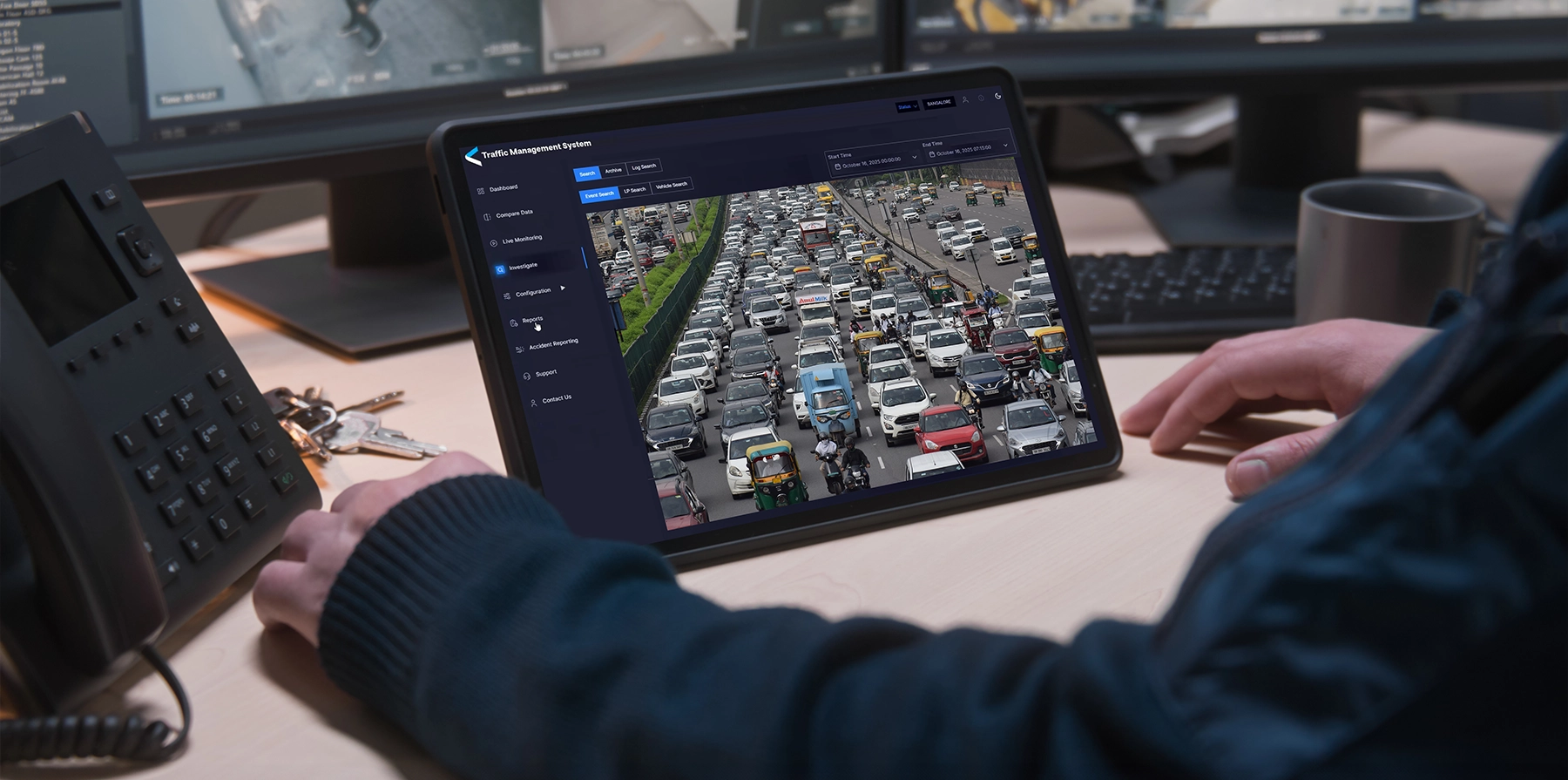
At the heart of intelligent urban mobility is Videonetics’ Advanced Traffic Management System (ATMS)—an AI-driven, decision-support platform built to help road authorities manage traffic proactively and with confidence. The system provides real-time traffic congestion detection, enabling authorities to identify bottlenecks early and take timely action to ease traffic flow across intersections, corridors, and highways.
Videonetics ATMS delivers accurate vehicle classification, offering granular insights into traffic composition, from two-wheelers and private vehicles to commercial fleets and heavy vehicles. Combined with Automated Number Plate Recognition (ANPR), the platform enables reliable vehicle identification and seamless vehicle tracking across camera networks—supporting traffic analysis, investigations, and situational awareness during both routine operations and critical incidents.
A key strength of the system lies in its AI-powered traffic violation detection, which identifies offences such as red-light jumping, over-speeding, lane violations, and illegal movements in real time. These capabilities are tightly integrated with e-ticket management software, streamlining the entire enforcement lifecycle—from evidence capture and violation validation to challan generation, payment processing, and audit trails. This reduces manual effort, improves compliance, and enhances transparency for authorities.
Built on a scalable and open architecture, Videonetics ATMS integrates seamlessly with command and control centers, enabling unified monitoring, faster decision-making, and data-backed policy planning. By transforming live traffic data into actionable intelligence, Videonetics empowers cities to reduce congestion, improve safety, strengthen enforcement, and deliver safer, smarter, and more efficient urban mobility—today and for the future.