BFSI security moves to AI-driven video infrastructure
19 March 2026
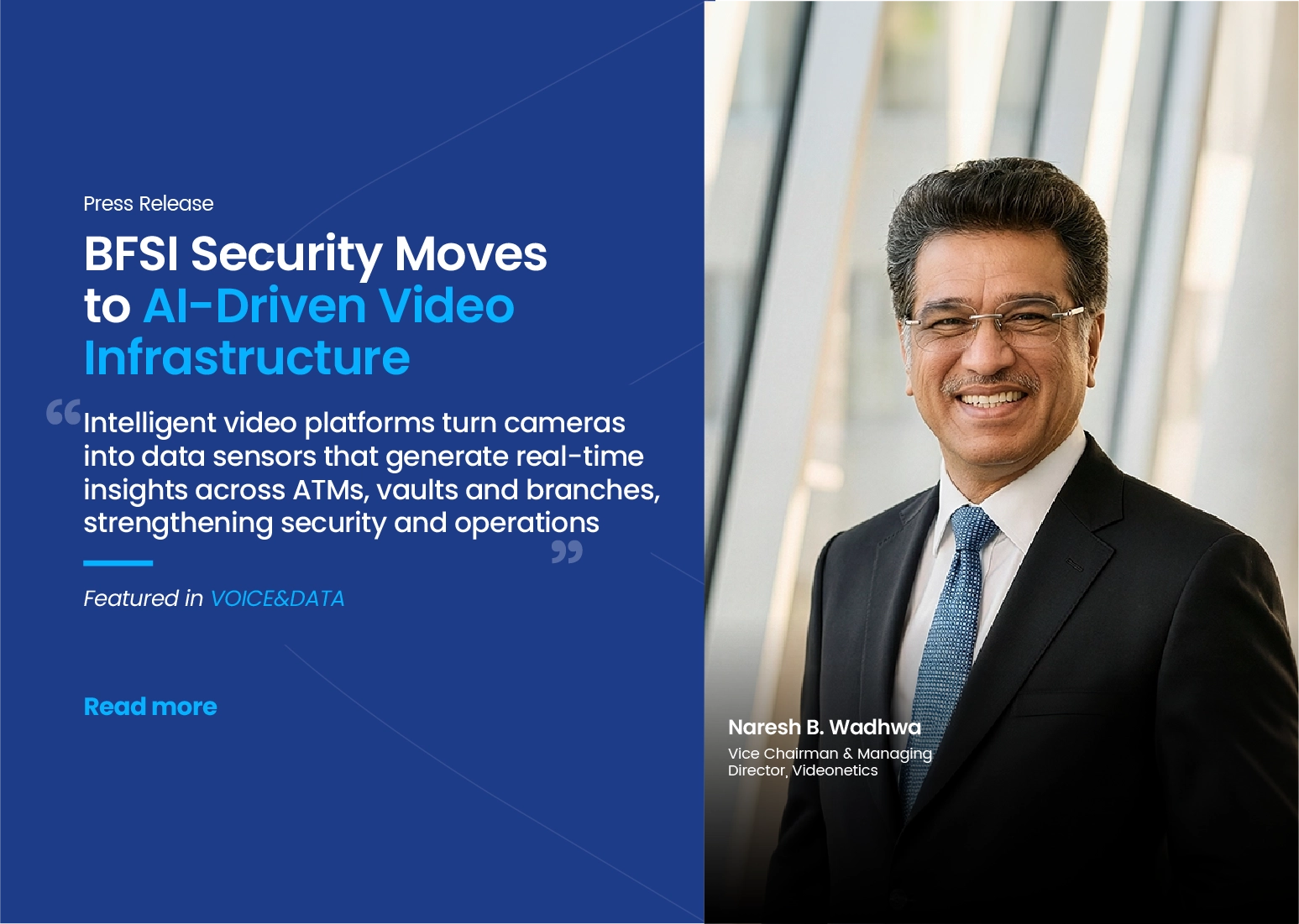
AI-enabled video platforms are emerging as critical digital infrastructure for banks, strengthening security, compliance, analytics and operational oversight.
By Naresh B Wadhwa
India’s banking and financial ecosystem is undergoing one of the most significant transformations in its history. With millions of daily transactions, a rapidly expanding network of branches and ATMs, and increasingly demanding consumers, financial institutions operate in a landscape that is far more dynamic and vulnerable than ever before. Security threats have evolved, operational complexity has multiplied, and customer expectations have shifted from basic service to seamless, frictionless experiences.
Intelligent video platforms turn cameras into data sensors that generate real-time insights across ATMs, vaults and branches, strengthening security and operations.
In Brief
For decades, bank surveillance systems largely functioned as passive recorders. They provided footage, but rarely intelligence. In an environment marked by sophisticated fraud attempts, rising physical security risks, and regulatory compliance requirements, this approach is no longer adequate. What the sector requires today is intelligent video infrastructure capable of anticipating risks, supporting rapid decision-making, and offering insights that enhance operations as much as security.
Modern video intelligence platforms can analyse live footage, interpret behavioural patterns, detect anomalies, and raise alerts before situations escalate, shifting from reactive to predictive capability. Institutions deploying these systems report rapid incident detection for high-priority scenarios such as ATM tampering or vault breaches, with significantly faster response times when integrated with automated workflows. This acceleration is critical: faster response times reduce loss severity, increase the likelihood of apprehending suspects, and minimise customer impact.
For institutions transitioning from legacy systems, a phased deployment strategy minimises disruption while delivering measurable value at each stage. The most effective approach begins with high-risk assets, ATMs and vaults, where security vulnerabilities are most acute, and ROI is clearest. Use cases such as loitering detection, tampering alerts, and vault access violations demonstrate immediate impact.
The second phase expands to branch networks, incorporating customer behaviour analytics, queue management, and compliance verification. Finally, institutions scale regionally, integrating mobile assets like cash vans while building centralised intelligence platforms. Critically, modern platforms overlay onto existing video management systems via standard protocols such as RTSP and ONVIF, avoiding costly infrastructure replacement.
The architecture of these systems is equally important. Attribute-based forensic search helps investigators quickly trace incidents using filters such as clothing colour, vehicle type, and movement direction.
The most effective deployments employ distributed intelligence: edge processing within cameras or on- premises appliances handles latency-sensitive tasks like intrusion detection and facial recognition, dramatically reducing bandwidth consumption.
Centralised platforms enable advanced correlation, forensic search, and enterprise-wide reporting, connecting data from thousands of endpoints. Integration
with existing VMS, access control, and SIEM platforms through open APIs ensures seamless workflows-when a vault breach is detected, the system simultaneously triggers SOC notifications, automated access lockdowns, and SIEM entries for correlation with other security events.
Compliance has become a major driver of adoption. As regulations expand to cover transparency and secure data management, including RBI mandates for 180-day video retention and camera placement at entry, exit, and vault locations, financial institutions must maintain clear, searchable trails of evidence.
AI-driven platforms streamline compliance by providing automated incident logs, centralised monitoring, and advanced search capabilities. What once took hours now completes in minutes, with far greater accuracy. Institutions report reducing audit preparation time from weeks to days.
Fraud investigation has been similarly transformed.Instead of manually reviewing hours of footage, investigators now use attribute-based searches, clothing colour, vehicle type, and movement direction to quickly trace incidents and close cases faster. These capabilities not only strengthen incident response but also create powerful deterrents against future crime.
Beyond security, these systems deliver operational insights that improve branch performance. AI analytics help banks understand customer behaviour, reduce wait times, and optimise layouts, with deployments showing measurable reductions in average wait times, creating data-driven insights comparable to those used in digital channels.
When evaluating platforms, decision-makers should prioritise several critical factors: interoperability through open APIs and ONVIF compliance to avoid vendor lock-in; cloud readiness for hybrid deployment models; data localisation capabilities to meet RBI requirements; robust cybersecurity posture, including end-to-end encryption and ISO 27001 certification; and AI governance with explainable models and comprehensive audit trails.
Platforms designed specifically for financial institutions tend to offer deeper compliance and fraud-detection capabilities than general-purpose surveillance tools. And the business case is compelling. Beyond the operational improvements already mentioned, these systems typically pay for themselves within 18–24 months through a combination of loss prevention, efficiency gains, and compliance cost savings.
The measurable impact extends across every dimension of security and operations, from seconds-fast threat detection to dramatically reduced investigation times to improved audit readiness. Of course, adoption must be guided by responsible AI principles, balancing innovation with privacy, preventing algorithmic bias, and ensuring human oversight to maintain public trust.
The institutions that invest in intelligent, future-ready surveillance will define the next era of financial security in India. This is not simply a technological upgrade but a strategic shift that strengthens customer trust, protects assets, enhances resilience, and ensures India’s financial backbone remains secure as it grows. In a country where financial inclusion is expanding at unprecedented speed, building smarter, more responsive security infrastructure is foundational to the stability and credibility of the entire ecosystem.
Media Contact: Marcom, marcom@videonetics.com
Note to Editors
About Videonetics:
Videonetics’ Unified Video Management Platform, powered by an indigenously developed True AI and deep learning engine, offers a comprehensive, modular, yet integrated solution. This platform includes cutting-edge applications such as Video Management System (VMS), Video Analytics (VA), Traffic Management System (TMS), and Face Recognition System (FRS). Additionally, Videonetics' Video Surveillance as a Service (VSaaS) Platform provides a cutting-edge, AI-powered, cloud-agnostic video management solution tailored for data centre companies, telecom providers, and managed IT service providers, for enabling organizations to achieve robust, scalable, and accessible cloud-based video surveillance. Trained on extensive data sets, our solutions are robust, intelligent, and adaptable across various industries and sectors. Our products are cloud-ready, cloud-agnostic, ONVIF compliant, and OS & hardware agnostic, ensuring they are scalable and interoperable.
Videonetics has been consistently ranked as the #1 Video Management Software provider in India and among the top 10 in Asia (OMDIA Informa TechTarget 2025). Driven by innovation, wired to ‘Look Deeper, we are committed to making the world a safer, smarter, and happier place.