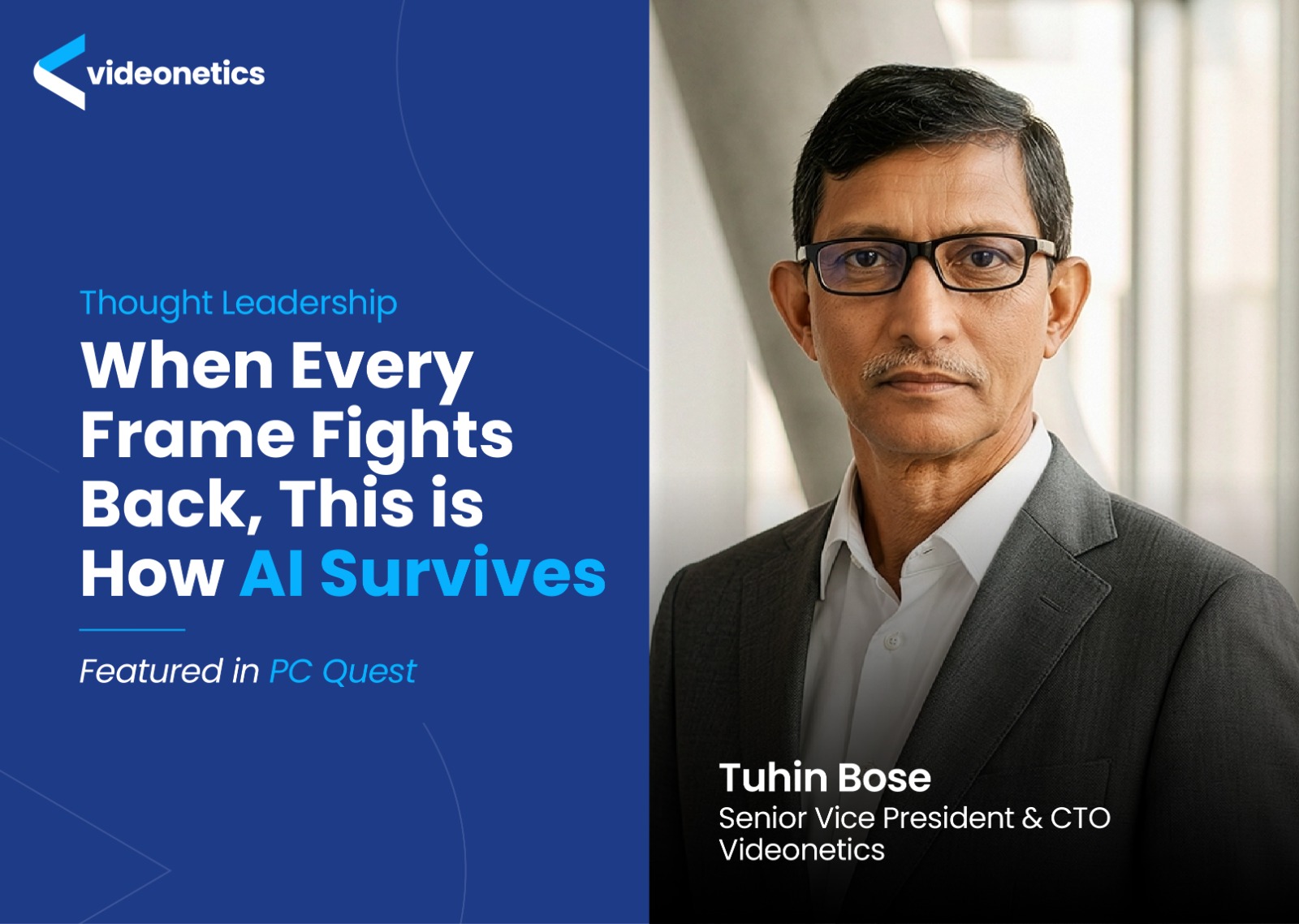
“Videonetics’ technology leadership outlines how India-led innovation is transforming AI-driven video intelligence to solve large-scale security and infrastructure challenges.
In a recent PC Quest interview, Videonetics articulated its strategic vision for the future of physical security and video intelligence, emphasizing the transition from traditional surveillance to AI-driven, outcome-led intelligence platforms. The article highlights Videonetics’ belief that modern security ecosystems must move beyond passive monitoring to deliver real-time awareness, predictive insights, and automated decision support.
Tuhin Bose, Sr. Vice President and CTO, Videonetics, highlighted the role of True AI—trained, contextual, and scalable—in solving complex challenges across infrastructure, smart cities, transportation, and enterprises. The discussion reinforced Videonetics’ focus on deep R&D, patented technologies, and indigenous innovation, positioning the company as a long-term technology partner rather than a point-solution provider.
The interview also emphasized the growing need for integrated ecosystems, where video management, analytics, access control, and command platforms work seamlessly together. Videonetics’ open, modular architecture was presented as a key enabler for interoperability, regulatory compliance, and future scalability across large, mission-critical deployments .
Overall, the PC Quest feature positions Videonetics as a thought leader in AI-powered security and video computing, driving safer, smarter, and more resilient ecosystems through innovation, collaboration, and trusted technology leadership.
What happens when AI meets chaotic traffic, low-grade cameras, and unpredictable weather? It stops being theory and starts fighting to survive. Inside the real world of video AI where every frame is a battlefield and only the robust make it out
Artificial Intelligence (AI) sits at the center of modern video computing. But once you move beyond demos and proof-of-concepts, the terrain looks very different. Real video is unpredictable. Environments keep shifting. Bandwidth is never guaranteed. And the systems must operate continuously without excuses. Few leaders understand this balance between intelligence and operational rigor better than Tuhin Bose, VP and CTO, Videonetics, who has spent over three decades building solutions for smart cities, transportation networks, and critical infrastructure.
Videonetics works in environments where video never stops, and reliability is non-negotiable. The company’s strength lies in blending deep AI with engineering discipline, especially across India’s complex public spaces. In our discussion, he broke down how video analytics has changed, what challenges remain unsolved, and why responsible AI must be engineered from the ground up.
How video AI has transformed over two decades ?
The biggest transformation in video analytics has come from shifting rule-driven detection toward learning-driven intelligence. Early systems relied on rigid heuristics and fixed thresholds. They worked only when the environment behaved perfectly. As scenes grew busier and cameras became more widespread, these handcrafted methods ran out of room.
Modern AI, in contrast, learns directly from data. It interprets movement, behavior, and context in ways that were not possible earlier. Yet this evolution brings dependencies. Models need large, diverse datasets and far more computational complexity. In a country like India, where lighting, density, and camera quality change rapidly, these demands compound. For Videonetics, this shift meant moving from algorithm-level tuning to full-stack system design that supports continuous training and long-term reliability.
Why high-quality video data remains the toughest challenge ?
Even as AI improves, the ability to gather high-quality, representative data remains a bottleneck. India’s diverse weather, traffic density, infrastructure gaps, and camera inconsistencies create enormous variation. Training data must capture these nuances, and that requires sustained, long-term effort.
Collecting video alone is not enough. Data must be curated, annotated, validated, and tested across domains that behave very differently. Scenes can vary drastically between cities or even between two streets in the same neighborhood. Videonetics has invested deeply in these datasets because without grounded, real-world samples, no model can generalize reliably. Robustness comes from breadth and realism, not volume alone.
When research concepts become production systems ?
In video AI, promising research ideas appear often, but very few survive the jump into production. Readiness depends on a mix of robustness testing, reproducibility, and architectural fit. A technique becomes mature only when it remains stable under varied inputs, handles noisy environments, and can be monitored, retrained, and maintained at scale.
Engineering decisions are practical rather than academic. Systems deployed across thousands of cameras must operate daily under fluctuating conditions. They must be explainable during audits, debuggable when issues arise, and stable enough to run for years. Novelty alone does not justify adoption. Sustainability does.
Engineering AI for India’s unpredictable environments
India challenges video analytics in ways few regions do. Lighting changes quickly, dust and rain distort images, and crowd density fluctuates minute to minute. Networks can be inconsistent, and infrastructure varies sharply by region. These realities influence every model and pipeline Videonetics creates.
Models must be resilient enough to handle distortions, occlusions, motion blur, and unpredictable behavior. Systems must continue performing even on lower-grade cameras or under severe bandwidth constraints. This fosters an engineering culture centered around adaptability. The goal is not just high accuracy in perfect conditions, but consistent accuracy when the environment becomes chaotic.
Designing systems that stay accurate despite noise
Maintaining accuracy with noisy input is one of Videonetics’ core strengths. The challenge is a layered problem. Preprocessing stabilizes and cleans video before it reaches the model. The model itself is designed to tolerate imperfect frames. The post-processing layer refines the output so the system remains dependable during fluctuations.
This multi-layer architecture prevents performance collapse when video becomes grainy, compressed, or obstructed. Instead of relying on a single stage, the system treats degradation as expected, not exceptional.
Architecting for city-scale deployments
Deploying video analytics at city scale introduces complexities far beyond the model itself. Compute must be distributed intelligently. Storage needs must evolve as video accumulates. Model lifecycle management becomes essential for maintaining consistent performance.
Videonetics uses a hybrid design that balances edge processing with centralized systems. Immediate decisions happen at the edge to reduce latency. Long-term analytics and archival tasks reside centrally. Models are versioned, tracked, and updated through structured workflows to ensure that the system remains aligned with changing environments. This architecture allows city-scale operations without overwhelming compute or bandwidth.
Embedding ethics and accountability in video AI
Video analytics often operates in sensitive environments. Cities, public spaces, and high-security areas rely on systems that must be both useful and accountable. Ethical AI is treated as a design requirement.
Ethical behavior is embedded at each technical layer. Access controls decide who sees what. Data governance defines storage duration and anonymization. Decision logs provide traceability. Bias testing ensures reliability across demographics and environments. Responsibility becomes part of engineering, not separate from it.
What responsible AI needs in practice ?
Responsible AI becomes meaningful only when enforcement is built into development and deployment. Reproducibility, structured validation, continuous monitoring, and human oversight become essential. Systems must detect when confidence is low. Fail-safe mechanisms must activate under uncertainty. Lifecycle management must ensure that outdated models do not continue unnoticed.
Responsibility is both an ethical and technical discipline.
Balancing sophistication with long-term stability
The pursuit of advanced algorithms is exciting, but complexity must not erode maintainability. Systems deployed for years cannot rely on fragile or opaque models. The best algorithm is often the one that remains stable and interpretable under pressure.
This balance shapes Videonetics’ choices in frameworks, architecture, and update cycles. Features must last. Systems must evolve gracefully. The full stack must remain operational even as conditions shift.
Why solutions engineered for India scale globally ?
Solutions built for India often succeed worldwide because they are engineered for adversity. Heat, dust, congestion, and infrastructure unpredictability create scenarios many countries never experience. Systems designed for these conditions naturally become more adaptable elsewhere.
Videonetics’ design philosophy emphasizes robustness, modularity, and environmental flexibility, and these traits travel well internationally.
Building teams that innovate responsibly
Leading engineering teams in mission-critical domains demands a mix of exploration and discipline. Experimentation is encouraged, but within frameworks that protect system stability. Failure is acceptable as long as learning is systematic and traceable.
The culture prioritizes collaboration, domain awareness, and hands-on engineering. The goal is to build deep-tech solutions without compromising the reliability needed for long-term deployments.
The innovations that will shape the next decade
The next chapter of video AI will be shaped by advances in edge-ready hardware, algorithmic optimization, distributed inference architectures, and deeper fusion of video with other sensory inputs. Future systems will also require stronger defenses against tampering and adversarial manipulation as deployments become more critical.
These advancements will redefine both performance ceilings and safety expectations.
A future built on engineered intelligence
Videonetics operates at the intersection of AI, public infrastructure, and real-world unpredictability. What emerges is a belief that reliable video intelligence is not only about smarter models. It is about smarter engineering. Success depends on systems that remain stable as conditions change, bandwidth drops, or environments become unpredictable.
As AI-driven video computing enters its next decade, this mindset of resilience, responsibility, and long-term engineering may define the technologies that endure.
Read the article here – PC Quest
Media Contact: Marcom, marcom@videonetics.com
Note to Editors
About Videonetics:
Videonetics’ Unified Video Management Platform, powered by an indigenously developed True AI and deep learning engine, offers a comprehensive, modular, yet integrated solution. This platform includes cutting-edge applications such as Video Management System (VMS), Video Analytics (VA), Traffic Management System (TMS), and Face Recognition System (FRS). Additionally, Videonetics' Video Surveillance as a Service (VSaaS) Platform provides a cutting-edge, AI-powered, cloud-agnostic video management solution tailored for data centre companies, telecom providers, and managed IT service providers, for enabling organizations to achieve robust, scalable, and accessible cloud-based video surveillance. Trained on extensive data sets, our solutions are robust, intelligent, and adaptable across various industries and sectors. Our products are cloud-ready, cloud-agnostic, ONVIF compliant, and OS & hardware agnostic, ensuring they are scalable and interoperable.
Videonetics has been consistently ranked as the #1 Video Management Software provider in India and among the top 10 in Asia (OMDIA Informa TechTarget 2025). Driven by innovation, wired to ‘Look Deeper, we are committed to making the world a safer, smarter, and happier place.

